

Looking to build an income online but overwhelmed by endless content creation? This complete guide to affiliate marketing with AI shows you exactly how to use AI tools to save time, create better content, and build a profitable affiliate business, even if you’re a complete beginner. Learn the 7-step system that successful affiliates use to promote products, drive traffic, and earn commissions without burning out.
Disclosure: This post contains affiliate links. I may earn a commission at no extra cost to you. I only recommend tools I’ve used or thoroughly researched. See full disclosure here.
Can You Make Money with Affiliate Marketing Using AI?
The Overwhelm at the Start
When I started exploring affiliate marketing, I asked myself this exact question. At first, hours went into writing blog posts, creating social media graphics, and researching products. I was completely overwhelmed by everything it took to get started.
However, at the same time, I discovered something that completely changed how I approach building an affiliate business: combining affiliate marketing with AI tools.
Because of this, the content that used to take me five hours to create was done in 30 minutes. My social media stayed consistent without the burnout. And most importantly, I had time to focus on learning strategy instead of just drowning in tasks.
The Shift That Changed Everything
Since then, I’ve learned you don’t need to be a tech wizard to succeed with affiliate marketing with AI. You don’t need expensive software or a huge following. Instead, what you need is a proven system that combines smart AI tools with effective affiliate marketing strategies.
In this guide, I’m walking you through the exact seven-step process that successful affiliates use to build their businesses with AI tools. On my site, I test and review AI tools specifically for online entrepreneurs, so everything I recommend here comes from hands-on experience.
So, whether you’re a complete beginner wondering how to make money with affiliate marketing or you’re already promoting products but want to scale faster, these strategies will save you time and set you up for success.
This post is all about affiliate marketing with AI.
- Can You Make Money with Affiliate Marketing Using AI?
- Why Affiliate Marketing with AI Is a Powerful Start for Beginners
- Step 1: Choose Your Niche for Affiliate Marketing with AI
- Step 2: Join Top Affiliate Programs That Actually Pay Well
- Step 3: Build Your Platform (Where You'll Share Your Affiliate Links)
- Step 4: Create High-Quality Content for Affiliate Marketing with AI
- Step 5: Strategic Content Types for Affiliate Marketing with AI
- Step 6: Turn Your AI Content into a Traffic-Generating Machine
- Step 7: Track and Scale Your Affiliate Marketing with AI Business
- Common Mistakes to Avoid in Affiliate Marketing with AI
- Your Action Plan: Getting Started Today
- Frequently Asked Questions About Affiliate Marketing with AI
- Don't Forget to Grab Your Free Guide
Why Affiliate Marketing with AI Is a Powerful Start for Beginners
Let’s start with the basics because if you’re new to this world, affiliate marketing might sound intimidating.
Here’s the simple version: Affiliate marketing is when you recommend products or services to your audience and earn a commission when someone makes a purchase through your unique link. Think of it like being a trusted friend who suggests great tools. In other words, you get paid for it.
Now add AI into the equation, and you’ve got a powerful combination that’s changing how people build online businesses.
AI tools automate the time-consuming parts of building an affiliate marketing business. For example, content creation, graphic design, social media scheduling, and email writing. In other words, AI handles these tasks so you can focus on what matters: building relationships and choosing the right products to promote.
Related Article >> Affiliate Marketing Tools & Apps to Run a Successful Business
How Affiliate Marketing with AI Saves You Time and Effort
When people ask me, “Can you make money with affiliate marketing?” my honest answer is yes, but only if you’re consistent. Otherwise, most people struggle.
I asked myself this exact question when I started exploring affiliate marketing. Spending hours every single day creating content. Blog posts, social media updates, email newsletters, product reviews, it’s exhausting. Consequently, most people quit before they see results.
Fortunately, that’s where AI comes in to solve the biggest problem: time…
How AI Boosts Your Affiliate Marketing Efficiency
Speed without sacrificing quality. Tools like QuillBot help you write better content faster. I use it to polish my writing, fix awkward sentences, and make my posts more readable, all in a fraction of the time it used to take.
Consistency becomes achievable. When you’re leveraging AI tools for affiliate marketing, showing up daily for your audience doesn’t mean sacrificing your entire life. I can create a week’s worth of social media posts in under an hour using Predis.ai.
Better targeting means smarter decisions. AI-powered tools help you understand what your audience actually wants. You’re not guessing which affiliate programs to promote. You’re making data-driven decisions.
Lower barrier to entry. Many free versions of AI tools for affiliate marketing exist, like ChatGPT and Claude, so you don’t need a huge budget to get started. I’ll share my favorite free options in Step 3.
In short words, affiliate marketing with AI doesn’t replace the human connection. It just gives you more time to build those relationships that lead to sales.
Step 1: Choose Your Niche for Affiliate Marketing with AI
Before you dive into promoting anything, you need to pick your lane. This is your niche, the specific topic area you’ll focus on.
I know what you’re thinking: “But I don’t want to limit myself!” Trust me, I felt the same way. However, here’s what I’ve learned with my experience, through research, and watching successful affiliates: trying to promote everything to everyone means you’re memorable to no one.
How to Pick a Profitable Niche for Affiliate Marketing
The sweet spot is finding something that checks three boxes:
You’re genuinely interested in it. Of course, you don’t need to be an expert, but you should care about the topic. If you hate fitness, don’t start a workout blog just because supplements have high commissions. You’ll burn out fast.
People are actively buying. Check if companies in your niche offer affiliate programs. In other words, if they’re willing to pay commissions, there’s demand. Look for AI tools, affiliate programs, SaaS products, digital courses, or physical products, depending on your interests.
Problems need solving. Specifically, the best niches address ongoing challenges. For example, online entrepreneurs constantly need help with content creation, time management, and growing their businesses. That’s why AI tools work so well for affiliate marketing; the demand is consistent.
Related Article >> Best Affiliate Niches in 2025: From Stuck to Unstoppable
My Experience Finding What Works
My niche has always been the make money online space. I’m passionate about helping people build online businesses and find legitimate ways to earn income from home.
Recently, I started incorporating AI tools as a major focus within that niche, kind of like a subniche. Not long ago, I realized that AI was becoming essential for anyone trying to succeed with affiliate marketing, and most people are overwhelmed by all the options. That’s when I shifted to testing and reviewing AI tools specifically for online entrepreneurs building affiliate marketing businesses.
The lesson here: Your niche can evolve, mine did. But having that clear focus, helping people succeed with affiliate marketing with AI, makes creating content and building trust so much easier.
Step 2: Join Top Affiliate Programs That Actually Pay Well
Where to Find the Best Affiliate Program Options
Here’s where to look for legitimate programs:
First, check individual company websites. Most companies list their affiliate programs in the footer under “Partners” or “Affiliates.” I’ve found programs this way for QuillBot, Predis.ai, and Simplified, all tools I’ve actually tested.
Next, explore affiliate networks. Platforms like PartnerStack, Impact, ShareASale, and CJ Affiliate host multiple affiliate programs in one place. This makes tracking easier since all your commissions are in one dashboard.
Then, use direct Google searches. Type “[tool name] + affiliate program” and you’ll discover programs you didn’t know existed. Sometimes the highest-paying AI affiliate programs aren’t heavily advertised.
Finally, join communities. Facebook groups, Reddit threads, and Discord servers where people discuss AI tools often share information about new affiliate opportunities.
Not all affiliate programs are created equal. Some look amazing on paper but have terrible conversion rates or complicated payout terms.
Here’s what to look for when evaluating any program.
Key Factors to Consider Before Joining
First, commission structure matters. Look for programs offering at least 20-30% recurring commissions. One-time payouts are fine, but recurring commissions mean you earn money month after month from a single referral. That’s the passive income goal.
Second, cookie duration affects your earnings. This is how long the tracking link stays active after someone clicks it. A 24-hour cookie means if someone doesn’t buy immediately, you don’t get credit. Look for 30-90 day cookies minimum.
Third, payment terms should be clear. When do they pay? How do they pay? What’s the minimum payout threshold? I’ve seen programs with $500 minimums, which is frustrating when you’re starting out. Aim for $50-100 thresholds.
Finally, product quality is non-negotiable. Only promote tools you’d genuinely recommend. I test everything before I promote it because my reputation matters more than any commission check. If a tool doesn’t deliver on its promises, I won’t promote it.
Related Article >> Affiliate Products for Beginners: Your First Commission Made Easy

Affiliate Programs That Convert: AI and Beyond
Based on my testing and research, here are categories and examples of solid programs:
Content creation and writing tools. QuillBot offers a generous affiliate program for its writing assistant. It’s easy to recommend because most online entrepreneurs need help with writing.
Social media management tools. Predis.ai and Simplified both have affiliate programs. These tools help busy entrepreneurs create social media content quickly, which solves a massive pain point.
Email marketing platforms. Kit (formerly ConvertKit) has an excellent affiliate program with recurring commissions based on what successful affiliates recommend. Email marketing is essential for affiliate success, so it’s a natural recommendation.
SEO and website tools. Rank Math and Ubersuggest both offer affiliate programs. Anyone building a blog or website needs SEO help, making these easy to recommend.
Hosting and infrastructure. Bluehost is one of the most recommended hosting platforms for beginners based on industry research. Their affiliate program has been around forever and is beginner-friendly.
Video and design tools. InVideo AI, Canva, and similar tools have strong affiliate programs because video content is huge right now.
These are just a few options you can look at, but there are so many more, and different ones for different niches. The key is mixing free tools for affiliate marketing with premium options. When someone can try a tool for free first, they’re more likely to convert to a paid plan through your link.
Step 3: Build Your Platform (Where You’ll Share Your Affiliate Links)
You can’t build an affiliate business if you don’t have somewhere to share your content and recommendations.
The good news? You have options. Even better, you don’t need to be everywhere at once.
Choosing Your Primary Platform
Think of your platform choices in two categories: your home base (what you own) and your outposts (where you meet your audience).
Your home base should be a blog. This is what I chose because you own your content completely, and a single well-optimized post can bring free traffic from Google for years. Popular Hosting options like Bluehost are affordable and reliable for beginners.
Set up WordPress, install an SEO plugin like Rank Math, and start publishing. Your blog becomes your home base, with everything pointing back to it.
Related Article >> Start Your Blog with Bluehost in 5 Simple Steps for Affiliate Success
Choose Your Social Platform: Meeting Your Audience
YouTube – works best for video lovers comfortable on camera. Video builds trust quickly because people see you using tools in real-time.
Facebook – is great for community building and engagement. This is where I started because I already knew how to use it.
Instagram – works well for visual content and repurposing what you’ve already created.
Pinterest – functions as a visual search engine for driving blog traffic. I’ve dipped into it but paused to learn the platform properly before diving back in.
TikTok – works for short-form video content and reaching younger audiences. It can go viral quickly, but requires consistent posting.
The Non-Negotiable: Email Marketing
No matter which platforms you choose, you must build an email list. This is the only audience you truly own. Platforms like Kit are popular among successful affiliates for managing subscribers and sending newsletters. Set this up early, even if your list is small. Every website visitor should see an opportunity to join your email list.
My Honest Experience with Platforms
Here’s a mistake I made: I jumped from one social platform to another without really building much traction on any single one. I’d post on one for a while, get frustrated, then try another platform, thinking that was the answer, but in reality, you get nowhere by doing that.
What did I learn? Pick one platform you genuinely enjoy for bringing traffic to your blog, if you have one. Then focus on it until you master it, and then you branch out to others. For me, that’s Facebook. I show up consistently on Facebook, and I’m building my blog by sending traffic from Facebook to it.
The other platforms? They’re bonuses for repurposing content, not my main focus. That clarity has made everything easier.
Step 4: Create High-Quality Content for Affiliate Marketing with AI
This is where the power of AI really shines for affiliate marketing. Content creation used to be the biggest bottleneck. Now, with affiliate marketing with AI, it’s one of the most streamlined parts. Using AI in my business makes things go by so much faster now.
My Current AI Content Creation Stack
QuillBot for writing assistance. I write my first draft, then run it through QuillBot to improve flow, fix grammar, and make sentences clearer. It’s beneficial when I’m tired and my brain isn’t cooperating. The paraphrasing, AI detector, and the Humanizer tools help me quickly rewrite awkward sections. You can check out my full QuillBot review to see how it works in action.
Predis.ai for social media content. This tool saves hours every week. I input my blog topic, and it generates social media posts, graphics, and even video ideas. Then I’ll customize them to match my voice, but having that starting point is huge. I share exactly how I use it to streamline my content in my full Predis.ai review.
Simplified for multi-format content. I’ve tested this tool extensively (you can read my full Simplified review here). It combines design, video editing, and AI writing in one platform. Perfect for creating everything from Instagram carousels to blog graphics.
ChatGPT or Claude for brainstorming. When I’m stuck on content ideas, I ask AI questions like “What are the biggest challenges online entrepreneurs face with content consistency?” and get dozens of blog post ideas instantly. I also use them to brainstorm strategies for my business, like planning promotions or mapping out new product ideas.
Rank Math for SEO optimization. This WordPress plugin, Rank Math, analyzes your content as you write and suggests improvements for keyword placement, readability, and technical SEO. Many successful bloggers recommend it, and using it effectively can help your posts rank higher on Google and drive more traffic to your blog.

My Step-by-Step Content Creation Process
Here’s exactly how I create affiliate content with AI tools:
Step one: Research keywords. I use Ubersuggest to find what people are actually searching for. This ensures I’m creating content people want, not just what I feel like writing about.
Step two: Outline the post. I ask Claude to help me structure my thoughts. You don’t copy and paste AI content. I use it as a brainstorming partner to make sure I’m covering all the important points.
Step three: Write the first draft myself. This keeps my authentic voice intact. I write like I’m talking to a friend over coffee, sharing what I’ve learned through testing platforms, with what my experiences were using them, and research I have done.
Step four: Polish with QuillBot. I paste sections into QuillBot to improve clarity, fix any grammar issues, and ensure the writing flows smoothly.
Step five: Create visuals. I use Predis.ai or Canva AI to create social media graphics and blog images that match my brand. No design skills required.
Step six: Optimize for SEO. Tools like Rank Math give you a checklist to make sure your post has the best chance of ranking on Google. Add keywords naturally, optimize images, and ensure proper heading structure.
Step seven: Repurpose everywhere. One blog post becomes multiple pieces of content. I pull quotes for Instagram posts, create a carousel summarizing key points, and share highlights on Facebook.
This entire process takes me about 3-4 hours for a comprehensive blog post. Before AI tools? It could take 8-10 hours minimum for most content creators.
Step 5: Strategic Content Types for Affiliate Marketing with AI
Random content doesn’t build an affiliate marketing business. Strategic content that guides people toward solutions, that’s what converts.
When people ask “can you really make money with affiliate marketing,” the answer is yes, but only if you’re creating content with intention.
Four Content Types That Drive Affiliate Sales
Product reviews are your bread and butter. Share your honest experience with the tools you’re promoting through affiliate programs. Include screenshots, talk about what you love and what could be better, and explain who the tool is perfect for.
I review tools on my site like QuillBot, Predis.ai, and Simplified because I actually test them. People can tell when you’re being genuine versus just trying to make a quick sale.
Comparison posts help people decide. Create content like “QuillBot vs Grammarly: Which Is Better for Bloggers?” or “Top 5 Free AI Tools for Affiliate Marketing.” These posts rank well on Google because people are actively searching for them when they’re ready to buy.
Step-by-step tutorials solve specific problems. Show people how to use AI tools to accomplish a specific goal. For example: “How to Create a Week of Social Media Posts in 30 Minutes Using Predis.ai.”
Tutorial content performs incredibly well because you’re providing immediate value while naturally demonstrating why the tool is worth considering.
Resource roundups position you as an expert. Lists like “Best AI Affiliate Programs for Beginners” or “Highest Paying AI Affiliate Programs in 2025” give you multiple opportunities to include affiliate links naturally while genuinely helping your audience find solutions.

How I Plan My Content Strategy
I always start by thinking about my audience’s actual problems. For instance, what questions do they ask? What keeps them stuck?
For example, I know my audience struggles with consistent content creation while running their businesses. So I create content about time-saving AI tools, batch content strategies, and realistic posting schedules.
Sometimes, the solution to their problem involves a tool I’m an affiliate for. Sometimes it doesn’t, and I’ll suggest a free alternative instead. Ultimately, that honesty builds trust, and trust eventually leads to people taking your recommendations seriously.
Step 6: Turn Your AI Content into a Traffic-Generating Machine
You can create the best content in the world, but if nobody sees it, you can’t build a successful business with affiliate marketing.
Traffic is the fuel for your business. Here’s how to get it without paid ads.
Organic Traffic Strategies
For your blog: SEO is your long-term asset builder. Optimize your blog posts for Google using tools like Rank Math. Research keywords with Ubersuggest and create content around what people are actively searching for.
Well-optimized blog posts can send traffic and generate opportunities for years after publication. That’s the power of SEO.
Related Article >> How Long Does SEO Take to Work: 7 Surprising Timeline Truths
Pinterest drives traffic as a search engine. If you’re in niches like online business, productivity, or lifestyle, Pinterest can be a goldmine. Create eye-catching pins for your blog posts using Predis.ai or Canva AI, and include relevant keywords in your pin descriptions.
Many successful affiliates spend just 30 minutes a week on Pinterest and get consistent traffic from it. It’s on my list to dive deeper into once I learn the platform better.
Guest posting and collaborations expand reach. Write guest posts for other blogs in your niche, appear on podcasts, or collaborate with other creators. Every appearance is an opportunity to drive new people back to your content.

Social Media for Engagement
Facebook builds relationships and community. I post on Facebook at least 4 times a week, sharing helpful tips, behind-the-scenes updates, and answering questions, not just promotional content. The key is starting conversations and being genuinely helpful. When people trust you through regular interaction, they’re more likely to check out your recommendations.
Instagram works for repurposing. Take your best-performing content from other platforms and share it on Instagram. It’s an easy way to expand your reach without creating entirely new content.
Email marketing for direct connection.
This is where real relationships are built. When you send value consistently, your email list becomes one of your most valuable assets. Successful affiliates send their lists honest tool reviews, free resources, and helpful strategies. When they mention an affiliate product, their email subscribers pay attention because trust has been established.
Related Articles >> What is Email Marketing? Building Real Engagement
Email List Building: 7 Proven Tips to Help Grow Your List
When to Consider Paid Traffic
Once your content starts gaining traction organically, paid ads can help you scale faster, but only if you already know which content converts.
What About Paid Ads?
Honestly? I don’t recommend paid ads for beginners. Here’s why:
You’re still learning what converts. Investing in ads before you know what works is risky. Start with free traffic methods first. Once you’re consistently getting results organically, then consider reinvesting some earnings into ads if you want to scale faster.
Step 7: Track and Scale Your Affiliate Marketing with AI Business
The final step is treating this like an actual business, not just a side hobby.
You need to know what’s working, what’s not, and where to focus your energy for maximum returns.
Tools for Tracking Your Performance
I use Google Analytics to show traffic sources. Install this free tool on your blog to see where visitors are coming from, which posts get the most traffic, and how people navigate your site.
Successful affiliates check Analytics weekly to see which content performs best so they can create more of what’s working.
You’ll want to use Pretty Links to organize affiliate URLs. This WordPress plugin lets you create short, branded links instead of ugly, long affiliate URLs. It also tracks clicks so you know exactly which links are getting attention.
Affiliate dashboards track earnings. Every affiliate program has a dashboard showing your clicks, conversions, and commissions. Check these regularly to see which products are generating interest.
Many affiliates keep a simple spreadsheet tracking monthly performance from each affiliate program. This helps identify top performers and areas to focus on.
If you’re using social media to drive traffic, Metricool shows you which posts perform best, when your audience is most active, and how your accounts are growing over time. Prdis.ai and Simplified do this as well. I guess it all depends on what you’re looking for, so I gave you a few options here.
How to Optimize for Better Results
Do more of what’s working. If product reviews get more clicks than listicles, create more reviews. If Facebook drives more traffic than Instagram, focus your energy there.
Update old content regularly. Go back to posts from six months ago and refresh them with new information, better keywords, and updated affiliate links. Google loves fresh content.
Related Article >> How to Update Old Blog Posts for SEO: Rank Higher in Google
Test different approaches. Try different headlines, various content formats, and new call-to-actions. Small tweaks can lead to significant improvements in conversions.
Build relationships with affiliate managers. Most ai tools affiliate programs have managers you can email. Introduce yourself, share your content, and ask if they have promotional opportunities. Sometimes they’ll offer exclusive bonuses or features for active promoters.
Invest in Your Education
One thing I can’t stress enough: invest in learning. I’ve purchased coaching and resources to help me grow in this space. I follow many successful people in affiliate marketing and the AI tools industry.
Learning from those who are a few steps ahead of you saves you time, money, and frustration. Whether it’s an SEO course, a coaching program for affiliates, or even just following the right people on social media, continuous education matters.
The online world changes fast, especially with AI. What works today might not work next year. Staying educated keeps you ahead of the curve.
Scaling Without Burning Out
Once you have a solid foundation, here’s how to grow without working more hours:
Repurpose content across platforms. Turn blog posts into YouTube videos, videos into blog posts, and both into social media content. One piece of content becomes five.
Batch create content. Set aside one day to create multiple weeks of content at once using AI tools. This creates consistency without daily stress.
Outsource the tasks you hate. As your business grows, consider reinvesting to hire help. Maybe someone to design graphics, edit videos, or manage your email list.
Focus on evergreen content. Create content about topics that stay relevant for years, not just trending topics that die out in weeks. Posts about how to use AI for affiliate marketing will be relevant for a long time.
Build systems and templates. Create templates for common content types so you’re not starting from scratch every time. Templates for product reviews, comparison posts, and social media captions save hours.
The goal isn’t to work yourself to death. The goal is to build a business that generates opportunities even when you’re not actively working on it.

Common Mistakes to Avoid in Affiliate Marketing with AI
Let me save you some time, money, and frustration by sharing mistakes I’ve made while building my affiliate marketing with AI business, and what I learned from them.
Buying Tools You Don’t Actually Need
I wasted money on tools that didn’t solve a current problem. I just bought them because they seemed cool or popular.
Lesson: Only invest in tools that address a real need in your business. Save your money until you actually need what the tool offers.
Jumping from Platform to Platform
I constantly switched social media platforms, never building traction on any single one. Frustrated by slow results, I kept hopping to the next platform.
Lesson: Pick one or two platforms and stay consistent. Focused effort beats scattered attempts across many.
Ignoring SEO from the Beginning
I regret not optimizing my posts from day one. Now, I have many unoptimized posts that I don’t have time to fix.
Lesson: Learn basic SEO and use tools like Rank Math from the start. Every post should be optimized. Future you will thank you later.
Skipping Research and Learning
I jumped in without understanding what I was doing, hoping results would come fast.
Lesson: Take time to research, learn from courses and successful affiliates, and understand the strategy before creating content. It saves you from costly mistakes.
Promoting Everything Instead of Staying Focused
Early on, I tried promoting every program I found. It just confused my audience and diluted my message.
Lesson: Stick to your niche and only promote products that genuinely serve your audience. Quality over quantity always wins.
Not Tracking What Works
I created content without checking performance, blindly producing more.
Lesson: Track everything from day one. Use Google Analytics and affiliate dashboards to focus on what actually drives clicks and conversions.
Forgetting to Disclose Affiliate Relationships
At first, I didn’t include disclosures, but it’s both ethical and legally required.
Lesson: Always add clear affiliate disclaimers. It builds trust and keeps you compliant with FTC guidelines.
Your Action Plan: Getting Started Today
Feeling overwhelmed? I get it. That’s a lot of information. But here’s the thing: you don’t have to do everything at once.
Start with this simple action plan:
Week 1: Choose your niche and research programs. Spend a few days deciding what you want to focus on and finding 3-5 relevant affiliate programs to join.
Week 2: Set up your platform. Whether it’s a blog, YouTube channel, or social media account, get your home base established. Don’t overthink it, just start.
Week 3: Create your first piece of content. Write a product review or comparison post using the AI tools I mentioned. Publish it even if it’s not perfect.
Week 4: Promote and repeat. Share your content, start building your email list, and create your next piece of content.
Related Article >> 6 Powerful Original Content Marketing Tips That Build Authority
That’s it. Four weeks to launch your journey with affiliate marketing with AI.
Will it generate thousands immediately? Probably not. But it will get you started, and starting is the hardest part.
Remember, every successful affiliate marketer online started exactly where you are right now—at the beginning, not sure if they could really make money with affiliate marketing, but willing to try anyway.
The difference between them and people who are still dreaming about it? They took action.
Frequently Asked Questions About Affiliate Marketing with AI
Getting Started and Timelines
Q: How long does it take to see results with affiliate marketing with AI?
A: It varies based on your consistency and traffic sources. Most experts recommend giving yourself 3-6 months of consistent effort before evaluating results. AI tools help you stay consistent with content creation, which is key to building momentum.
Q: Do I need a website to start affiliate marketing with AI?
A: Not required, but highly recommended. You can use social media or YouTube, but a blog is an asset you own. If Instagram shuts down your account, you lose everything. A website gives you control and can generate traffic for years through SEO.
Tools, Costs, and Setup
Q: What’s the best free AI tool for affiliate marketing beginners?
A: ChatGPT (free version) for brainstorming and outlining, QuillBot’s free plan for polishing writing, and Canva’s free version for graphics. These three cover your basic needs without any upfront cost.
Q: How much does it cost to start affiliate marketing with AI?
A: You can start with $0 using free tools and platforms. To build a blog, expect $50-150 for the first year (hosting + domain). Premium AI tools run $10-30/month each, but aren’t necessary at first. Many successful affiliates started completely free.
Marketing Without the Tech Overwhelm
Q: Can I do affiliate marketing without social media?
A: Yes! SEO and blogging work great if you don’t want to be on social media daily, although it is a slower process. A well-optimized blog posts can bring in traffic for months or years. However, email marketing is essential regardless of your strategy.
Q: What if I’m not tech-savvy?
A: You don’t need to be! I’m not either. Most AI tools are designed for beginners with simple interfaces and tutorials. If you can use Facebook or email, you can learn these tools. Start with one at a time and use free trials.
High-Paying Affiliate Program Options
Q: Which AI affiliate programs pay the highest commissions?
A: Many tools offer 20-40% recurring commissions. Some pay 50%+ for the first month or year. The “best” program is the one your audience actually needs. I focus on tools I’ve tested because I can authentically recommend them.
Don’t Forget to Grab Your Free Guide
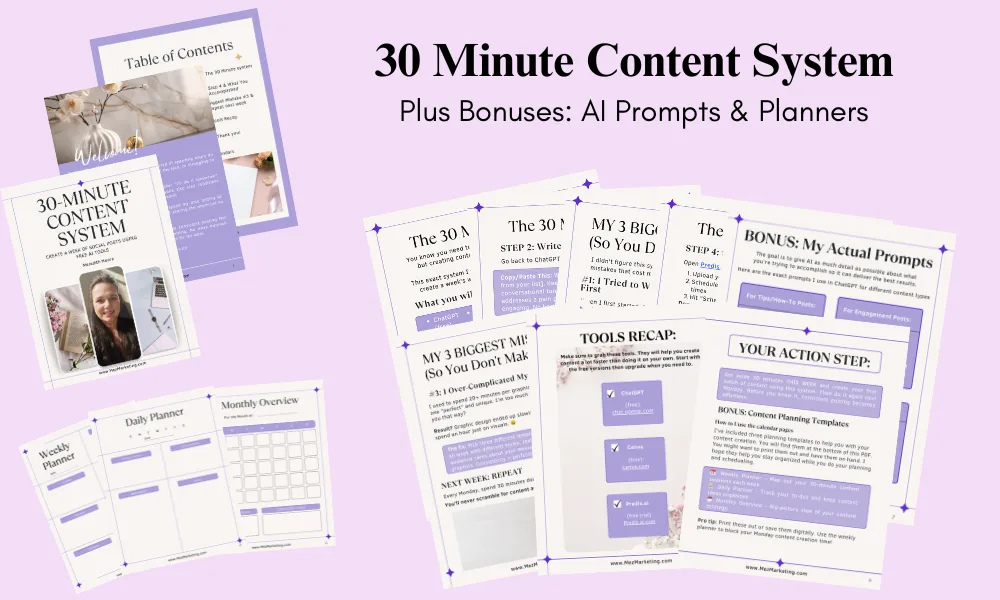
Before you go, I want to set you up for success with my free 30-Minute AI Content System. This guide shows you exactly how to create a week of social media posts in just 30 minutes using free AI tools—the same process I use to stay consistent without burnout.
Inside, you’ll learn how to brainstorm content ideas in 5 minutes, write posts that sound like you (not a robot), create graphics quickly, and schedule everything to save hours every week. Plus, you’ll get my complete free AI tool stack and bonus planning templates.
Just fill out the form below and your free guide will be sent straight to your inbox.
We respect your privacy. You can unsubscribe at any time.
Let’s stay connected! Follow me on social media for more tutorials, honest tool reviews, and behind-the-scenes tips as I build my affiliate business. I’d love to hear about your wins. Big or small, because every step forward matters.
Here’s to building a business that gives you time freedom, location freedom, and the potential to create real income.
To our success,

P.S. Share this post with a friend who’s been thinking about starting affiliate marketing but doesn’t know where to begin. Sometimes all we need is a little push and the right roadmap.


Hi Meredith,
Another great tool I wish I would have had my hands on when I started, LOL!
This is probably one of the most complete “how to get started as an online entrepreneur” that you can get. You talk about the good, the bad and the ugly and that’s the part people who start online usually don’t get: the truth.
It isn’t easy but with tools like this and support, definitely can be done. Thanks for making this available. Cheers!
Hey Marc!
I’m really glad you found it helpful. Getting started online can feel like a rollercoaster sometimes, so sharing the real ups and downs is important to me. With the right tools and support, it really is doable. Appreciate you taking the time to leave a comment. Cheers to you, too!
Hi Meredith – This post is jam packed with incredibly important information. For anyone getting started in this affiliate marketing online business, this should be required reading! You have summed up so many answers to questions that I had when I initially got started. As times are changing, and AI is becoming the new norm, it is important that we adapt so not that we get left behind, but so that we can continue to remain ahead. Thank you for taking the time to write this important peace and for doing the research for us!
Hi Ernie!
Thank you! I remember having all those same questions when I first started too. Things change fast, especially with AI, so staying flexible really makes a difference. I appreciate you taking the time to comment, and I’m happy the post made things a bit easier for you!
This post is one I will go through again. AI is really a tool to save time. There’s a way to use Chat GPT to cut time in more than half if you give it the role of executive assistant. I’m learning about that, now!!
Hey Kate!
Totally! AI can really reduce your workload and save a significant amount of time when used effectively. Giving ChatGPT an “assistant” role is a smart move. It makes everything faster and easier. Sounds like you’re on a great path already! Thanks for stopping by…