

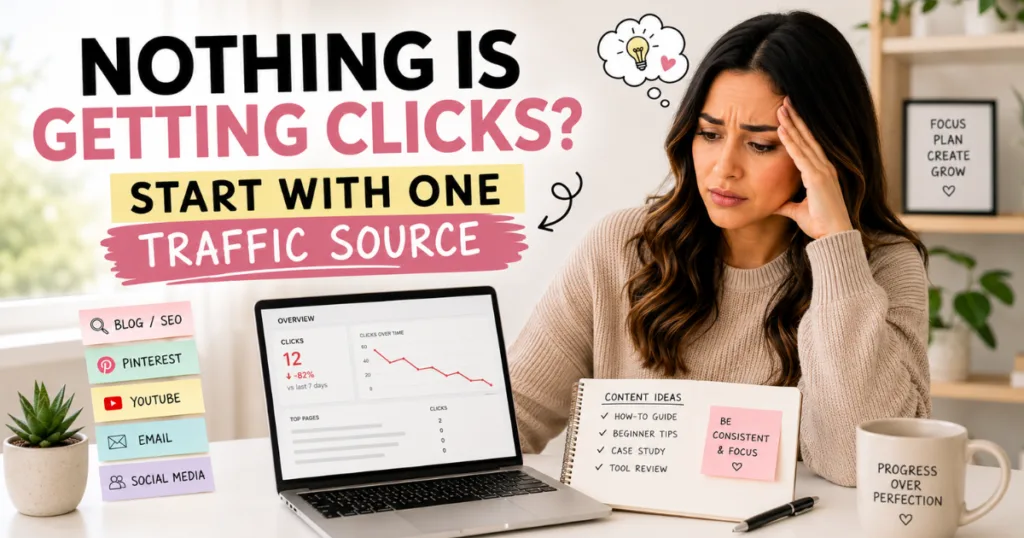
Are you creating content, posting in different places, trying new tools, and still wondering why nothing is getting clicks?
That is one of the most frustrating parts of building anything online.
You feel like you’re doing the work. You may be writing blog posts, sharing on Facebook, making pins, testing AI tools, sending emails, or trying to show up wherever someone told you traffic was “easy.”
But instead of steady clicks, you get silence.
And that usually makes you wonder if you picked the wrong platform, the wrong tool, or the wrong strategy.
I know how frustrating that feels because I’ve had content get impressions, but not enough clicks to match the work I put into it.
Updated post on July 2026: This post was refreshed to reflect better on today’s traffic challenges, including choosing one main traffic source, using AI tools with more direction, and avoiding the overwhelm of trying to post everywhere at once.
Affiliate Disclosure: This post may contain affiliate links, which means I may earn a commission at no additional cost to you. You can find the full disclosure here.
- Why Nothing Is Getting Clicks Yet
- Quick Answer: What Is the Best Traffic Source for Beginners?
- Why Beginners Struggle to Get Traffic Online
- How to Choose the Right Traffic Source First
- What Beginners Need to Know About Free Traffic
- Best Traffic Sources for Beginners to Consider First
- My Simple Recommendation for Beginners
- Common Traffic Mistakes Beginners Make
- Final Thoughts: Start With One Traffic Source
Why Nothing Is Getting Clicks Yet
The problem isn’t always your content. A lot of the time, the problem is that you are trying to get traffic from too many places before one traffic source has had a chance to work.
That’s why choosing the best traffic source for beginners matters more than trying to post everywhere.
You don’t need to be everywhere right away. You need one main place to focus first, a simple plan you can repeat, and a way to track what is actually bringing people to your website, email list, or offer.
AI tools can help with that. They can help you plan content, write faster, repurpose ideas, create graphics, schedule posts, and understand what is working, but AI works best when it’s supporting a clear traffic strategy, not replacing one.
In this post, I’ll walk you through how to choose the right traffic source first, which free traffic sources for beginners are worth considering, when paid traffic makes sense, and how AI tools can help you stay consistent without posting everywhere.
Quick Answer: What Is the Best Traffic Source for Beginners?
The best traffic source for beginners is the one your audience already uses to look for answers, and the one you can stay consistent with long enough to learn what works.
For most beginners, that usually means starting with one search-based traffic source, like blogging with SEO, Pinterest, or YouTube. These platforms can help people find your content after you publish it, instead of disappearing within a few hours like many social posts do.
If you are a blogger, affiliate marketer, online entrepreneur, or small business owner, I would not start by trying to master every platform.
I would start with this simple traffic plan:
- Choose one main traffic source.
- Create helpful content for that platform.
- Use email marketing to stay connected with people who find you.
- Use AI tools to make the process faster and easier.
That is the smarter way to get traffic. Not louder, not everywhere, just more focused. That’s where a better traffic strategy starts, not with more platforms, but with one clear place to focus first.
Why Beginners Struggle to Get Traffic Online
Most beginners don’t struggle with traffic because they are not trying. They struggle because they don’t have a clear traffic plan yet. Sometimes the traffic problem isn’t really a traffic problem yet… It is a clarity problem.
If you are not sure who you are trying to help, what problem you solve, or what your business is built around, every traffic source starts to feel confusing.
That’s why I like Internet Profits Academy as a starting point for beginners. Their free 60 Minute Model ONE™ Challenge helps you figure out your topic, audience, and direction before you waste time creating content for the wrong people.
Why Every Platform Feels Like the Right One
One day, you hear that blogging is best. Then someone else says Pinterest is faster. Then another person says you need YouTube, Facebook, TikTok, paid ads, email, and short videos.
That gets overwhelming fast!
Once you know your audience and the problem you are helping them solve, choosing a traffic source becomes much easier. The truth is, every traffic source works differently.
- Blogging depends on search intent and helpful content.
- Pinterest depends on keywords, visuals, and consistency.
- YouTube depends on helpful videos that people want to watch.
- Social media depends more on attention, timing, and engagement.
So when beginners jump from one platform to another too quickly, they never give one traffic source enough time to learn what is working.
AI tools can help with a lot, but if you’re creating content for five platforms with no clear traffic goal, AI might just help you create more confusion faster.
That’s why the goal is not to create more content first. The goal is to choose the right traffic source first, then use content and AI tools to support that one strategy.
How to Choose the Right Traffic Source First
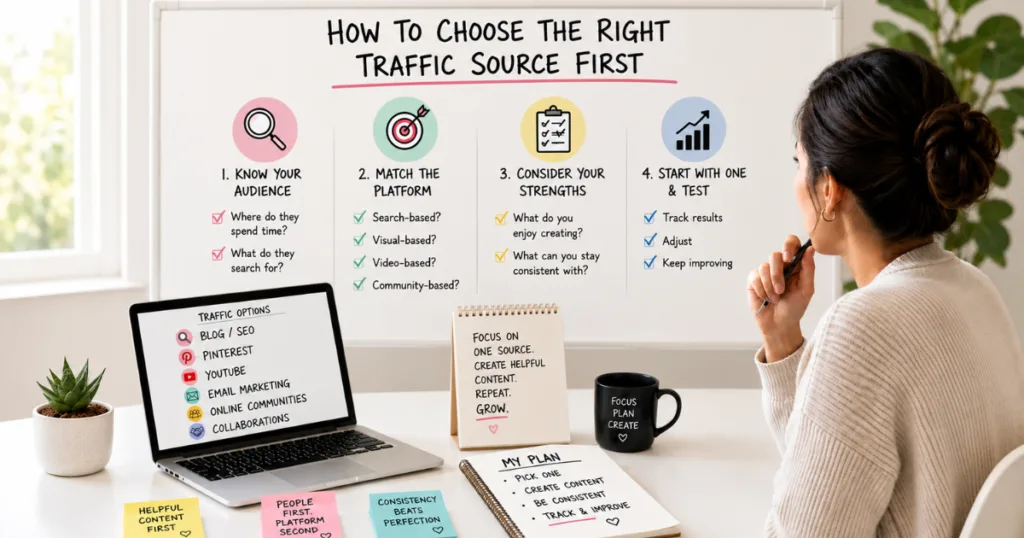
Choosing a traffic source should start with your audience, not the platform. The best traffic source for beginners is the one that matches how your people already look for help and what you can realistically keep creating.
For example, if your audience searches for reviews, tutorials, or answers, starting a blog and incorporating SEO into it may be a good place to start.
If your topic is more visual or idea-based, Pinterest may make more sense, or if people need to see how something works, YouTube could be a better fit. I’m a visual learner, so these are always good for me.
And if your business depends on trust, conversations, or personal connections, email, Facebook, or online communities may help you build stronger relationships.
To narrow it down, just ask yourself:
- Where are my people already looking for help?
- What type of content can I create every week?
- Do I need long-term traffic, faster visibility, or more connections?
Once you choose one traffic source, AI tools can make the work easier.
They can help you brainstorm ideas, outline content, write drafts, create pin text, repurpose posts, and track what is working, but AI is the helper, not the strategy.
What Beginners Need to Know About Free Traffic
Free traffic sounds simple, but it’s not effortless.
Organic traffic doesn’t usually happen just because you publish a blog post, make a pin, post on Facebook, or upload a video. It takes time for platforms to understand your content, for people to trust you, and for you to learn what actually gets clicks.
That does not mean free traffic isn’t worth it. It means you need to be realistic.
Why Free Traffic Starts Slow
Search-based traffic sources, like starting a blog using SEO, Pinterest, and YouTube, can be powerful because people are already looking for answers on these platforms, but they usually require patience, consistency, and helpful content that is better than another generic AI-written post.
That’s where a lot of beginners get stuck. They use AI to create more content, but not always better content. I’ve tested enough AI tools to see this clearly. Faster content only helps when the topic, audience, and traffic source make sense first.
What to Focus on Instead
The goal is not to flood the internet with posts. The goal is to create content that helps a real person solve a real problem and gives them a reason to click, read your content, trust you, and come back.
That is why I think it’s good for beginners to start with organic traffic first, but only when it is focused.
It usually moves slowly at first because platforms need time to understand your content, and you need time to learn what your audience actually clicks on. It’s slow, but it gives you useful data you can improve from.
You’re not just trying to get quick clicks. You’re building a traffic source that can grow over time as you learn what your audience responds to and likes.
Pick one main traffic source, learn how it works, and create helpful content for that platform. Then use AI tools to speed up the parts that save time.
That is a much better strategy than trying to post everywhere and hoping free traffic magically shows up, because it doesn’t and won’t unless you put the time and effort into it.
Need Help Creating Content for One Traffic Source?
If you’re trying to get traffic and struggling with the output of your content not hitting the mark, then you need simple prompts that help you plan better ideas, write faster, repurpose what you already created, and stay focused on the traffic source you chose first.
Grab my free 25 AI Prompt Toolkit to help you create content with more direction and less guessing.
Just fill out the form below, and the prompts will be sent straight to your inbox
We respect your privacy. You can unsubscribe at any time.
Best Traffic Sources for Beginners to Consider First
Once you understand that free traffic takes time, the next step is choosing the right traffic source to focus on first. Not every traffic source does the same job.
Some help new people discover you, some will help you build trust, and some work better for written content, while others work better for visuals, videos, or conversations.
The goal is not to pick the most popular platform. The goal is to choose the traffic source that gives your type of content the best chance to reach the right people.
Below are the main traffic sources I would look at first as a beginner, along with who each one is best for, when it may not be the right fit, and how AI tools can help make the process easier.
1. Blog SEO: Best for Long-Term Search Traffic
Blogging with SEO is one of the best traffic sources for beginners who want people to find their content through Google.
It’s not the fastest way to get traffic, especially in the beginning, but it can be one of the most valuable because your content can keep working after you publish it.
On my own blog, I’ve seen SEO start with small signs first, like impressions, a few clicks, or longer visit time, before it becomes steady traffic. It took me a while to get my website structured correctly so Google would start to look at me.
It works best when your audience is already searching for answers, reviews, comparisons, tutorials, or how-to help type content, and making sure you put the proper keywords in your content that people are searching for on Google.
When impressions show up before clicks on my website, that usually tells me Google may be starting to understand my topics better, but the title, angle, or promise may still need work to get more clicks. It’s always a work in progress.
It’s a slow process, but it is worth it in the long run. That’s why it’s important to structure your website correctly and write valuable posts so Google can understand who you are and what you offer, so it will start testing your site.
Related Article >> How Long Does SEO Take to Work: 7 Surprising Timeline Truths
Make the Topic Specific
For example, instead of writing a broad post like: “Best AI Tools.”
A beginner might do better with a more specific post like: “Best AI Tool for Writing Emails When You Don’t Know What to Say”

That kind of topic solves a clear problem, which gives people a better reason to click.
It’s best for: Bloggers, affiliate marketers, online entrepreneurs, and small business owners who want long-term traffic.
Not ideal for: Anyone who needs fast results this week or doesn’t want to create helpful written content.
How AI can help: AI tools can help you brainstorm keyword ideas, outline posts, rewrite messy sections, create meta descriptions, and repurpose blog content into emails, pins, or social posts.
AI can help you create content, but your experience is what makes the content useful. Add your own examples, opinions, screenshots, test results, and lessons so it doesn’t sound like every other AI-written post.
Google also recommends creating helpful, people-first content, which is why your own experience and examples matter so much. You should check it out. It has some great information if you are going this route.
When I use AI to help me with blog content, I treat AI like it’s my helper, and not the final voice. I review and edit everything with my own experiences and thoughts that I ask AI to give me.
If you need help choosing the right writing tool, this AI writing tool guide can help you compare what each tool is best for.
Beginner tip: Start with one specific reader problem, write the most helpful answer you can, and give the post time to work before jumping to another traffic source.
2. Pinterest: Best for Visual Search and Blog Traffic
Pinterest can be a helpful traffic source for beginners because people use it to search for ideas, tips, tutorials, and solutions. It works best when your content can be turned into a clear, clickable visual.
Pinterest describes itself as a place where people discover new ideas, which is why clear keywords and strong pin wording matter a lot with Pinterest and getting seen.
Pinterest is not fast traffic, though kind of like Google. From using Pinterest for my own blog, I’ve learned that impressions can look encouraging, but outbound clicks are what tell you if the pin promise is strong enough.
When my pins get impressions but no outbound clicks, I know the design may be getting seen, but the promise probably is not clear or helpful enough yet, so I will go back and adjust the pin to see what takes.
Make the Pin Promise Clear
A pretty design helps, but the real difference is usually the wording. You want to ask yourself when creating pins. Does the pin make someone think, “That’s exactly what I need help with”?
Instead of a pin that says: “Traffic Tips,” this is too vague and broad.
A stronger pin might say: “Posting Everywhere and Still Getting No Clicks?” Now that speaks to the real problem people might be having.
It’s best for: Bloggers, affiliate marketers, content creators, and small business owners with helpful or idea-based content.
Not ideal for: Anyone who wants instant traffic or does not want to test different pin titles and designs.
How AI can help: AI tools can help you turn one blog post into pin title ideas, descriptions, text overlays, and different content angles. If you need help with creating nice visual graphics, then Canva can help you create them faster.
Beginner tip: Start with a few pins for one blog post, test different pain points, and watch which wording gets the most clicks.
If you’re not sure when to use ChatGPT versus Canva, I break that down for you in this comparison post.
Related Article >> Canva AI vs ChatGPT for Content Creation
3. YouTube: Best for Tutorials and Trust
YouTube can be a strong traffic source because people go there to learn, compare, and see how something works. It is especially helpful if your topic needs explaining, demonstrating, or showing steps.
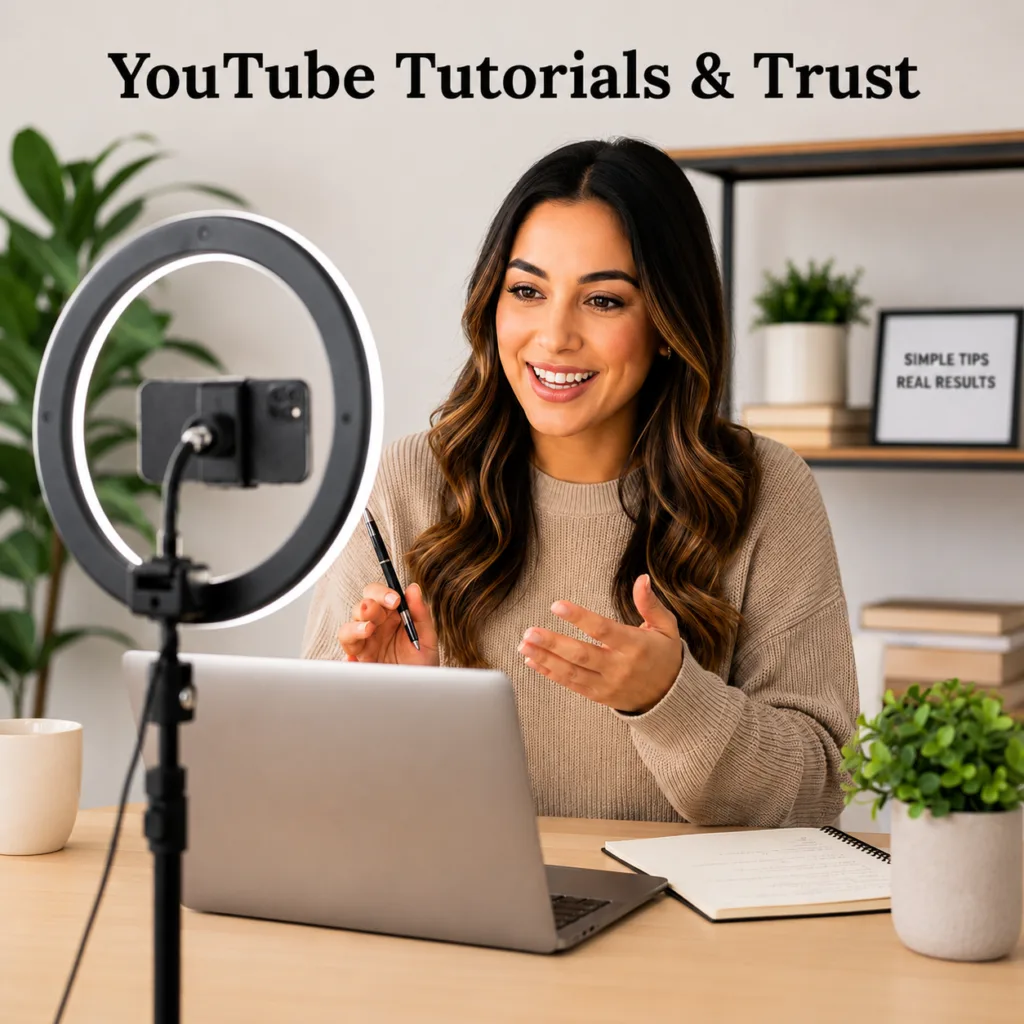
A blog post can tell someone what to do, but a video can show them. YouTube can work really well, but it may not be the easiest place for every beginner to start.
It all depends on what you are looking for and what you’re comfortable with. It takes a little more confidence to be on camera, more time for setup, and more time than writing a blog post or creating a Pinterest pin.
If you are new to video and want to learn more, YouTube’s creator resources can help you learn the basics of setting up a channel and creating content.
It’s best for: tutorials, product reviews, tool demos, comparisons, and topics where people want to see the process.
Not ideal for: anyone who is not ready to be on camera or does not want to create video content yet. I did video for a while on TikTok, and it ended up not being my thing.
How AI can help: AI tools can help you turn a blog post into a video outline, script, title ideas, description, and short clips for social media.
If you want a beginner-friendly video tool, you can also read my InVideo AI review to see what happened when I tested it.
Beginner tip: Do not start with long, complicated videos. Start with one helpful tutorial or simple screen-recording that answers a specific question your audience is already asking.
4. Email Marketing: Best for Keeping the Traffic You Earn
Email marketing is not usually the first place people discover you, but it is one of the best ways to stay connected after they do. Unlike social media, your email list is something you own, so you’re not depending only on an algorithm to reach your audience.
That matters because getting someone to your website once is hard enough. You don’t want them to read one post and disappear forever.
Your email list lets you bring people back to your content, share helpful tips, and recommend tools or resources when they make sense.
It’s best for: Bloggers, affiliate marketers, online entrepreneurs, and small business owners who want to build trust beyond one click.
Not ideal for: Anyone who only wants quick traffic and doesn’t want to create regular helpful emails.
How AI can help: AI tools can help you turn one blog post into email ideas, subject lines, outlines, and simple follow-up emails.
Beginner tip: Don’t wait until you have a lot of traffic to start building your list. Even a small list is valuable if the people on it care about what you are sharing.
If email is the traffic follow-up system you want to build, my AI email marketing strategies post can help you see more ways AI can support your email content and list growth.
5. Facebook & Online Communities: Best for Conversations and Trust
Facebook groups and online communities can help beginners get traffic by joining conversations that are already happening. This works best when you are helpful first, and not just dropping links in the comments.
People are more likely to click when they feel like you understand their problem and are giving a real answer, not just trying to send them somewhere.

It’s best for: Beginners who like conversations, answering questions, and building relationships on platforms like Facebook.
Not ideal for: Anyone who only wants to post links and not give helpful information.
How AI can help: AI tools can help you turn common questions into post ideas, it can give you helpful replies, blog topics, and email topics.
Beginner tip: Pay attention to the questions people ask over and over. Those questions can become blog posts, emails, social posts, and even affiliate content because they show you what people really need help with.
6. Paid Traffic: Best After You Know What Converts
Paid traffic can help you get seen faster, but I would not make it the first step for most beginners just starting out.
If you don’t know your audience, what your message is yet, what you want to offer, or have your landing page set up yet, then paid ads can get very expensive quickly, and you will get nowhere with it.
Free traffic helps you learn what people click on, what questions they ask, and what content gets attention before you start spending money. You have to learn that part first before you start throwing money away.
It’s best for: People who already know their audience, have a clear offer, and understand what content or message is working.
Not ideal for: Beginners who are still guessing at their niche, audience, or offer.
How AI can help: AI tools can help you write ad ideas, headlines, landing page copy, and different versions to test.
Beginner tip: Do not pay for traffic just because organic traffic feels slow. First, make sure your message is clear, and your content gives people a real reason to click.
7. Social Media: Best for Visibility
Social media can help beginners get seen, but it’s not always the best place to depend on for steady website traffic.
Posts on Facebook, Instagram, TikTok, or LinkedIn usually move fast, so they work better when they support your main traffic source.
It’s best for: Visibility, connection, quick tips, and sending people back to your blog, email list, or offer.
Not ideal for: Beginners who are already overwhelmed or expecting every post to bring clicks.
How AI can help: AI tools can turn one blog post into captions, Facebook posts, short video ideas, and quote graphics.
A scheduler can also help you stay consistent without posting manually every day.
Beginner tip: Create the main piece of content first, then use social media to share pieces of it instead of starting from scratch every time.
Bonus: Collaborations Can Help You Borrow Trust
Collaborations can help you get in front of a new audience faster, especially when someone else already has trust with the people you want to reach.
This could be a guest post, podcast interview, email swap, Facebook Live, expert quote, or simple creator partnership.

It’s best for: Building trust, growing reach, and getting introduced to the right audience.
Not ideal for: Beginners who are not clear on their topic, audience, or message yet.
How AI can help: AI tools can help you write outreach emails, pitch ideas, interview questions, and follow-up content.
Beginner tip: Start small and look for people with a similar audience, not necessarily the biggest audience.
My Simple Recommendation for Beginners
If you are just starting out, don’t try to build traffic from every platform at once. Start with one main traffic source that makes sense for you and your business, and one way to stay connected with the people who find you.
A simple beginner setup could be:
- Blogging using SEO + email if you like writing helpful posts.
- Pinterest + blog content or offers/email if your topic works well visually.
- YouTube + email if your audience needs tutorials or demonstrations.
- Communities + blog/email if your business depends on trust and conversation.
But before you choose a traffic source, make sure you are clear on your topic, audience, and the problem you solve.
That’s where the free 60 Minute Model ONE™ Challenge inside Internet Profits Academy can help. It helps beginners figure out their topic and audience before they waste time creating content for the wrong people.
Get the free 60 Minute Model One Challenge. Once you have that clarity, pick one traffic source and use AI tools to help you plan, create, repurpose, and track what is working.
Common Traffic Mistakes Beginners Make
Even the best traffic source will not work well if the strategy is not clear. Here are a few mistakes to avoid.
Trying to grow everywhere at once
Pick one main traffic source first, then add more later after you have mastered your main one.
Using AI to create more content without a plan
AI can save time, but only when the content has a clear purpose. Then that’s when AI can speed things up for you.
Giving up too soon
Organic traffic usually starts slowly. Look for small signs first, like impressions, clicks, saves, comments, or longer visit time.
Writing for keywords instead of people
Keywords matter, but the content matters more and needs to solve a real problem. It needs to be helpful for your readers so they come away thinking “That was exactly what I needed”.
Ignoring what the data shows
If a title, pin, post, or topic gets clicks, learn from it and dissect the content to figure out what worked so you can repeat it. If it does not, adjust the angle instead of quitting. Making mistakes is how we all learn.
The goal is not to do everything perfectly. The goal is to keep improving one traffic source until you understand what works.
Final Thoughts: Start With One Traffic Source
The best traffic source for beginners is not the one everyone else says you “have” to use. It’s the one that fits your audience, your content style, and what you can stay consistent with long enough to learn from.
If nothing is getting clicks right now, that doesn’t always mean your content is bad. It may mean your traffic strategy needs more focus and an adjustment, like testing a stronger title.
Start with one main traffic source, learn how it works, create helpful content for the people you want to reach, and then use AI tools to make the process easier, not more complicated.
And remember, traffic gets easier when you are clear on who you help and what problem you are trying to solve for your audience. If you are still figuring that part out, the free 60 Minute Model ONE™ Challenge inside Internet Profits Academy is a good place to start.
That way, you’re not just creating content and hoping people find it. You’re building around one audience, one problem, and one clear direction. Get the help you need and take the free 60 Minute Challenge.
Small steps count here. Choose the traffic source that makes the most sense for you, keep learning from what the data shows, and let each piece of content help you get a little clearer.
Thanks for stopping by, and remember that one focused traffic source is a much better start than trying to be everywhere at once.

Share this post with a friend or family member who needs to hear this. It might just be the push they need to finally get started.


Can’t believe I’m still learning new words and practices. Never imagined that PIN would turn out to be such an important word in this journey. Thank you again for introducing me to another new opportunity.
Hey Judith,
Isn’t it wild how we keep learning something new all the time? I’m so glad it helped open up another door for you. You’re doing amazing!
Meredith
This post holds a goldmine of advice. And it is thorough. Of course, trying them all at once would be a mistake. Certainly the ones that a person is most attracted to is a sign to stick with it for however long. Pinterest is an important organic traffic site. I’m not ready for that just yet!
Hey Kate,
Thank you! I’m so glad you found it helpful!
And you’re absolutely right, it’s best not to try everything at once. Starting with what feels right is the perfect way to go. Pinterest is a great traffic source, but there’s no rush. When you’re ready, it’ll be there waiting for you! Just take it one step at a time! 💛
Meredith
Funny how it all goes back down to the basics? right?
Great post with some very important information that we all must keep in mind.
Without the traffic, we’re just another pebble in the sand. Thanks for reminding me that with time and good practices, I can be that shiny pebble that everyone wants to pick up even if I’m in the sand!
Hey Marc,
Yes! It really does all come back to the basics, doesn’t it?
I love how you said that, we’re all just pebbles until we start shining with the right traffic and consistency. And you can absolutely be that shiny pebble everyone notices! Just keep showing up and doing the work, your time to shine is coming!
Meredith
Hi Meredith – Wow! This post is jam packed with incredible advice about what may help us become successful. So many things get in the way and one of them is patience. We all want it fast and we all want it right now, right? With the right tools and the rice process success will come at the right time and that’s what this post speaks to me about. I’ve heard you talk about SEO strategy before, and this is something that I really need to focus on. I need to find a good SEO plugin For my website as well as use better keywords to drive traffic. I’m still investigating Pinterest and wondering what the best strategy for me is at the moment. I appreciate this information!
Hey Ernie!
Thank you so much, I’m really glad my post was valuable for you!
And yes, patience is a big one! We all want fast results, but with the right tools and a steady pace, success comes at just the right time.
Since you’re focusing on SEO and looking into Pinterest, here are a few quick recommendations to get you started:
✨ For SEO: Try Rank Math it easy to improve your site’s search visibility.
✨ For keyword help: Ubersuggest is simple to use and super helpful for finding ideas.
✨ For Pinterest: Tailwind can save you tons of time by scheduling pins and giving strategy tips.
You’re asking all the right questions, just take it one step at a time. You’re doing great!
Meredith
Oh my goodness, this post is a lifesaver! 🙌 I’ve totally been in that spot—feeling like I’m doing everything but still crickets on the dashboard! I love how you broke down all the different traffic sources here. SEO especially—I’ve been sleeping on it, but your tips are making me wanna give it another go.
Pinterest is another one I’ve been meaning to check out properly, and your pin creation ideas are giving me life. Also, I really needed that little push to get back into email marketing. So many people talk about it, but you’re right, it’s all about the value and building trust. Gonna start small and see where it goes!
Hey Sarah,
Ahh, I’m so happy to hear this helped you! 🙌 You are *not* alone, I’ve totally been in that same spot, wondering why things aren’t clicking. It can be so frustrating!
I’m glad the traffic tips got you thinking again about SEO and Pinterest, they really can make a big difference once you start using them. And yes, email marketing can feel like a lot, but starting small is exactly the right move. Just keep focusing on giving value and being real, people notice that!
You’ve got such a great attitude already, and I can’t wait to see where this takes you! 💛 Keep going, you’re doing amazing!
Meredith
Meredith, the reminder to master one source at a time really landed for me—so simple, but game-changing. I used to bounce between platforms, thinking I had to do it all… and ended up doing none of it well.
What I’m still figuring out is: how do you actually master a traffic source? And for anyone else diving into that process, I’d love to know what tools helped you level up. I’ve been starting to use tools like Kaladata for TikTok to help me analyze videos that are doing really well to gain insights into hooks and concepts that are resonating.
Loved this post—packed with insight and zero fluff. Looking forward to the next part in the series!
Hey Alison,
I’m so glad that tip about mastering one traffic source at a time clicked for you, it really makes a huge difference! Trying to do everything at once is like juggling too many balls and dropping them all, right?
To really master a traffic source, I focus on learning what works best for that platform, testing different ideas, and paying attention to the results. Tools like Kaladata for TikTok are awesome for spotting what hooks and trends catch people’s attention. For Pinterest, I like using Tailwind to schedule and track pins, and for SEO, plugins like Yoast SEO or Rank Math help a lot.
It’s all about steady learning and tweaking as you go. Thanks so much for the kind words—I’m pumped to share more in the next part! Stay tuned!
Meredith
Meredith, this is packed with exactly the kind of info I wish I had when I first started out. I remember wasting so much time trying to do everything at once, YouTube, TikTok, blogging all without any clear focus, and barely seeing any traffic. Once I committed to just learning SEO and building an email list properly, things finally started to change. Your breakdown of each traffic source is super helpful, especially how you’ve added real examples and tools. I’ve bookmarked this post and will be coming back to try Pinterest next, never thought of it as a long-term traffic tool until now!
Hey Atif,
Thank you so much! I can totally relate, I did the same thing in the beginning, trying to be everywhere at once and getting nowhere fast. It’s amazing how much changes when you slow down and really focus on learning one thing well, like you did with SEO and email.
I’m so glad the breakdown and examples helped! Pinterest is such a hidden gem for long-term traffic, it doesn’t move as fast as TikTok or YouTube, but the traffic lasts way longer. I’m excited for you to give it a try! Let me know how it goes when you do!
Meredith