

If you are trying to make money online, one of the hardest parts is knowing which opportunities are worth looking into and which ones should make you walk away.
A polished website, screenshots of big earnings, testimonials, or promises of an “easy system” can make almost anything look legitimate at first, but a real opportunity should be able to explain how the business works, what you are actually expected to do, what it costs, and what kind of results are realistic.
In this guide, I’ll show you the warning signs I look for before trusting an online money-making opportunity, including newer “make money with AI” claims, task scams, pressure tactics, vague business models, and unrealistic income promises.
You’ll also get a simple checklist you can use before paying for a program, joining an opportunity, or handing over personal information.
Affiliate Disclosure: This post contains affiliate links, which means I may earn a commission at no extra cost to you if you purchase through my links. I only recommend tools I’ve personally tested and believe will add value to your business. You can find the full disclosure here.
- Why Online Money-Making Scams Are So Convincing
- 7 Red Flags of Online Money-Making Scams
- Legit Opportunity or Scam? Look at the Offer, Not Just the Platform
- Common Scam Tactics to Avoid
- 5 Questions to Ask Before Joining Any Online Program
- What to Do If You’ve Been Scammed
- A Safer Next Step If You Want to Build an Online Business
Updated post: August 12, 2026
This guide now includes current online scam tactics, warning signs, and practical steps to help you evaluate opportunities before you pay or join.
Why Online Money-Making Scams Are So Convincing
Online money-making scams don’t always look obviously fake. Some use professional websites, familiar business terms, testimonials, income screenshots, or even AI to make the opportunity sound more believable.
The FTC continues to warn about business opportunities that promise large earnings, passive income, or impressive results with little effort. Recent cases have also involved companies promoting AI-powered systems while making misleading claims about earnings and business growth.
Other scams take a simpler approach. You may receive an unexpected message offering easy online work such as liking videos, rating products, or completing “optimization” tasks. The platform may even show fake commissions building up before asking you to put in your own money.
That is why knowing the warning signs matters. A scam can cost you money, personal information, and time, but it can also make it harder to trust legitimate opportunities later.
7 Red Flags of Online Money-Making Scams
Here are the warning signs I would look for before paying for an online opportunity or handing over personal information.
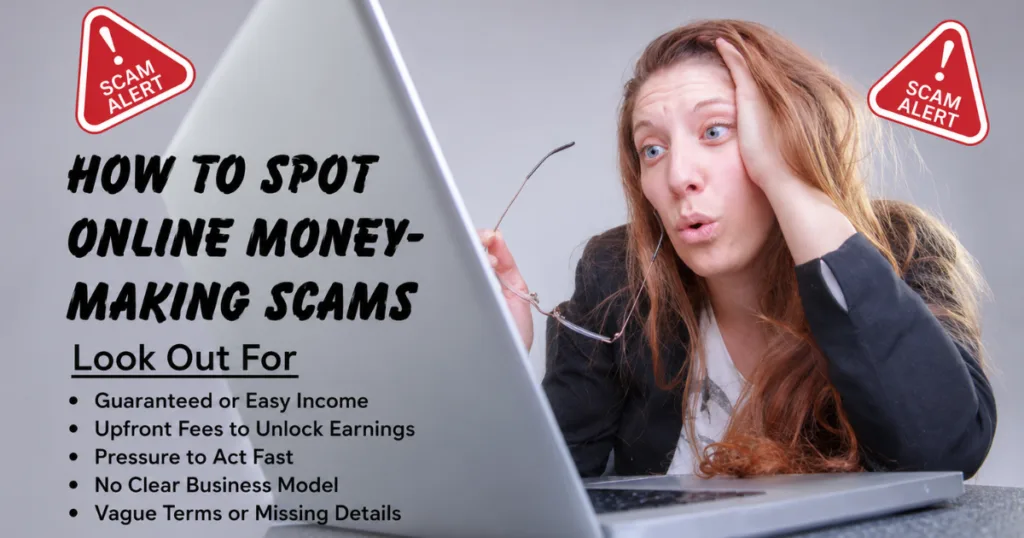
1. Guaranteed or Unusually Easy Income
Be cautious when someone promises a specific income, guaranteed results, or large returns with very little work. Legitimate businesses involve effort, learning, testing, and risk. The FTC specifically warns about offers that promise guaranteed income, big returns, or a “proven system” for making money.
2. Huge Results for Very Little Effort
Claims such as “make thousands your first month,” “set it up once and get paid forever,” or “AI does everything for you” deserve a closer look.
AI can speed up parts of content creation, but it still needs your direction, judgment, and editing. If you want to see what that looks like in practice, I explain my process for how to use AI to create content faster without sounding like AI.
I’m sure you have heard the saying “Nothing in life is free or easy.” Well, it is true.
The question to ask is simple: What work am I actually expected to do, and how does that work produce revenue?
3. Pressure to Buy or Act Immediately
Watch for countdown timers, “today only” offers, repeated messages, or claims that you will lose your chance forever if you do not buy right away.
A legitimate opportunity should give you enough information and time to make a thoughtful decision.
4. No Clear Explanation of How the Business Makes Money
You should be able to understand:
- What product or service is being sold
- Who the customer is
- What your role is
- How money is actually generated
If the explanation stays vague or focuses more on earnings than the actual business model, that is a reason to slow down.
5. “Proven Systems” or Secret Formulas Without Real Evidence
Words like proven, automated, secret, guaranteed, or done-for-you can sound impressive, but they do not prove that a business model works.
Look for clear explanations, realistic expectations, and evidence that supports any earnings claims and not just screenshots or testimonials. The FTC warns that testimonials and success stories can be misleading or even fake.
6. You Have to Pay Money to Unlock Earnings
Paying for legitimate training, software, or education is not automatically a scam.
The red flag is when someone says you must deposit or send money before you can receive earnings, unlock commissions, complete a task, or get paid for a job. The FTC says paying money to get paid is a strong sign of a scam.
7. Missing Company Details, Terms, or Refund Information
Before paying, look for clear information about the company, pricing, refund policy, terms, support, and what you are actually buying.
One simple check I still recommend is searching the company or program name along with words like “scam,” “review,” or “complaint.” The FTC recommends this too, but don’t rely on one review alone. Look for repeated patterns across multiple sources.
Legit Opportunity or Scam? Look at the Offer, Not Just the Platform
A familiar website or well-known company name can make an opportunity feel safer, but that should not be the only reason you trust it.
Instead, look at the specific offer in front of you and ask yourself:
- Does it clearly explain what you will be doing?
- Can you understand how the business actually makes money?
- Are the costs and refund terms easy to find?
- Are the income claims realistic and supported?
- Can you research the company and the people behind the offer?
- Are you being given enough time to make a decision?
The FTC recommends researching the company or program before paying and being especially cautious of guaranteed income, big returns, “proven systems,” or vague explanations of how the opportunity works.
A legitimate platform can still contain an offer that is not right for you. The goal is to learn how to evaluate each opportunity on its own, rather than relying on a company name or logo to decide for you.
The same idea applies when you are building your own online business. You don’t need to chase every platform or strategy at once. If you’re unsure where to focus, my guide to choosing the best traffic source for beginners explains how to pick one place to start and build from there.
Common Scam Tactics to Avoid
Fake Earnings or “Pay to Unlock” Schemes
Be cautious if a platform shows you earnings or commissions but then says you must pay a fee, deposit money, or buy something before you can withdraw them.
That is very different from paying for legitimate software, training, or a business service. The red flag is when your own money is required to release money you supposedly already earned.
Recruitment-First Pyramid Schemes
Some opportunities focus far more on recruiting new people than selling products or services to real customers.
The FTC warns that pyramid schemes can look similar to legitimate multi-level marketing businesses and may even sell real products. A major warning sign is when the compensation depends heavily on recruiting rather than genuine retail sales.
Fake Coaching or Business Opportunities
Scam offers may promise a ready-made business, special system, coaching, or access to high earnings without clearly explaining what you are buying or what results are realistic.
The FTC has taken action against business-opportunity and coaching schemes that used misleading earnings claims to persuade people to pay large amounts of money.
The important thing is not to avoid every paid program or business opportunity. It is to understand what you are paying for, how the business works, and whether the claims are supported before you spend money.
5 Questions to Ask Before Joining Any Online Program
Before you pay for a course, a coaching program, a community, or a business opportunity, slow down and ask yourself these five questions.
Can I clearly understand what I am buying?
The offer should explain what is included, what you will be doing, and what support or training you will receive.
Are the costs and refund terms clear?
Paying for legitimate training or tools is not automatically a red flag. Be cautious when important costs are hidden, new fees appear later, or you are pressured to keep paying to unlock promised results.
Can they explain how the business actually makes money?
You should be able to understand what is being sold, who the customer is, and how your work could realistically lead to income.
Are the earnings claims realistic?
Be skeptical of guaranteed income, unusually large returns, or promises that require very little work. The FTC continues to warn that these are common signs of business-opportunity and coaching scams.
What do independent sources say about the company?
Search the company or program name with words such as “review,” “complaint,” and “scam.” Look at several sources rather than relying only on testimonials shown by the seller, because reviews and success stories can sometimes be misleading or fake.
You don’t need every opportunity to look perfect. All you need is enough clear information to understand what you are buying, how it works, what it costs, and what expectations are realistic before you make a decision.
And if part of the appeal is a promise that a tool or program will suddenly make content creation effortless, it helps to understand what a realistic workflow actually looks like.
My content creation system for beginners shows the simple process I use to plan and create content without starting from scratch every time.
What to Do If You’ve Been Scammed
If you think you have already sent money or personal information to a scammer, act quickly.
- Stop communicating with the scammer.
- Contact the bank, card company, payment app, gift card company, or transfer service you used. Tell them the payment was connected to a scam and ask whether it can be reversed. The FTC recommends acting as quickly as possible because recovery may depend on how you paid.
- Report the scam to the FTC at ReportFraud.ftc.gov. Your report can help investigators identify patterns and warn others.
- Change passwords or PINs if you gave the scammer login information or access to an account.
- Protect your credit if personal information was exposed. A credit freeze or fraud alert can make it harder for someone to open new accounts in your name.
Be especially careful after a scam. Someone may contact you claiming they can recover your money for a fee. The FTC warns that refund and recovery scams specifically target people who have already lost money.
Getting caught by one bad opportunity does not mean every online business or paid program is dishonest. The better approach is to slow down, understand exactly how an opportunity works, check the claims, and know what you are paying for before moving forward.
A Safer Next Step If You Want to Build an Online Business
Once you know what warning signs to avoid, the next question is usually: what does a legitimate online business actually look like?
If you are still trying to figure out what topic you could build a business around, Internet Profits Academy offers a free 60 Minute Model ONE™ Challenge designed to help you identify one audience, one problem, and one solution based on what you already know, enjoy, or have experienced.
Inside the free community, you can also access step-by-step guidance, coaching, support, and connect with other members, including me, who are building alongside you.
I like this as a next step for you because you can learn how the business model works and see if it makes sense for you before going any further.
See what’s inside Internet Profits Academy and join for free here
The goal isn’t to find a shortcut… It’s to understand what you’re building so you can make smarter decisions from the start.

If this post helped you in any way, please share it with another small business owner or content creator who you think it might help.




It’s been so overwhelming worrying about scams. I didn’t know where to start. Thank you for giving me this much needed information.
Hi Judith,
I totally understand, it can feel really overwhelming at first. I’m so glad this info helped you and gave you a place to start. You’re not alone in this, and just taking that first step is a big deal. Thanks for coming by and have a nice day!
Meredith
Seems like when it comes to making money online not just those of us wanting to improve our situation financially are constantly competing against other marketers, but against these scammers as well. Which then puts more pressure on us to differentiate ourselves from the others. Whenever when we can get tools like your list it helps bring that pressure down. Thanks for your input and work in making this helpful tool.
Hi Ken,
Thank you so much! You’re absolutely right, it’s not just about standing out from other marketers, but also proving we’re not like the scammers out there. That pressure can be a lot. I’m really glad the list helped take some of that weight off. Tools like that make it easier to stay focused and build something honest. Thanks again for your kind words, they really mean a lot!
Meredith
Hi Meredith – This topic, not this post, really hit a nerve. Scammers are everywhere and they make legitimate business owners and people who are looking for solutions and value targets. This really angers me as I know that so many people have fallen for traps that have hurt them financially which leads to other issues. Thank you for your practical advice on what to look for and even as a bonus, you included some reputable solutions. I truly appreciate this post!
Hi Ernie,
I totally get what you mean, this topic hits a nerve for me too. It’s so upsetting how scammers take advantage of people who are just trying to build something real or find help. You’re right, it can hurt more than just your wallet. That’s why I wanted to share some clear signs to watch out for and offer a few trusted options to help people move forward safely. Thanks for coming by and have a nice day!
Meredith
It’s honestly wild how many “too good to be true” offers pop up. Your red flags list is gold—especially the pressure tactics one (been there, almost clicked 😅). Love how you break everything down without the fluff, and your journey from nail tech to online earner is super inspiring!
Hi Sarah,
I know, right? Those “too good to be true” offers are everywhere! I’ve almost clicked on a few myself That’s why I really wanted to share the red flags, especially the pressure tactics. I’m so glad you found it helpful, and it means a lot that you liked hearing about my journey. If it helps even one person stay safe and keep going, it’s all worth it!
Meredith
We are most vulnerable when we step outside the box and try new things, like starting our businesses, and people see vulnerability as an opportunity to take advantage. This is such an important post, Meredith! Love the simple checklist — so many people jump in without asking those key questions. Been there, learned the hard way too. Thanks for keeping it real and looking out for the rest of us!
Hi Alison,
Thank you so much! You said it perfectly, we really are the most vulnerable when we’re just starting out and trying something new. Sadly, that’s when scammers try to take advantage. I’m so glad the checklist helped! I’ve learned a lot the hard way too, and I just want to help others avoid those same mistakes. Thanks for your support,it truly means a lot!
Meredith
What a good idea you have had to write about scam. Scammers are everywhere but particularly noticeable online. What is more insulting than being a victim of a scammer? It’s so present that people must be aware and prepared to identify scam. Your post does that very well. I like you included a section about what to do if you have been scammed. It is a plague in our business and we must know how to report them efficiently.
Martin
Hi Martin,
Thank you, Martin! You’re so right, scams are everywhere online, and it’s such a frustrating and hurtful thing to go through. That’s why I felt it was important to talk about it and help people know what to watch out for. I’m glad the part about what to do if you’ve been scammed stood out to you—that info can really help someone in a tough spot. The more we talk about it, the more we can protect each other. Thanks again for your thoughtful comment!
Meredith
Meredith, Thanks for sharing this — I’ve been building my affiliate business while juggling family life and a full-time job, and I’ve definitely come across a few sketchy offers. One program promised big daily payouts just for sharing links, but when they asked for an upfront “training fee,” I backed out. I’ve since stuck to platforms like Warrior + and Amazon Associates, and they’ve been solid. Your checklist is a great reminder — I keep a similar one saved on my phone to stay sharp. Scams can shake your confidence, but with the right tools and real info, it’s still possible to build something genuine online.
Hi Atif,
Thank you so much for sharing this! It sounds like you’ve been through a lot while building your business, and I’m really glad you trusted your gut and walked away from that sketchy offer. That training fee red flag gets so many people. Warrior+ and Amazon Associates are smart choices—they’re solid and reliable. I use Amazon Associates but not Warrior+, I’ll have to check it out. Staying sharp and informed really makes a difference. You’re absolutely right—scams can be discouraging, but with the right tools and real support, we can build something real and lasting online. Keep going, you’re doing great!
Meredith